
The Encor Series 1: A Bold New Chapter for the Lotus Esprit Legacy
For discerning automotive aficionados with a substantial appetite for the extraordinary, the landscape of vintage automotive revitalization often presents a familiar, albeit impressive, tableau: the meticulously restored or reimagined Porsche 911. While these iconic machines command undeniable respect, a certain ennui can creep in for those seeking a more profound, perhaps even audacious, departure from the well-trodden path. Enter the Encor Series 1, a masterfully crafted homage to the legendary Lotus Esprit, poised to electrify the senses and reawaken the thrill of bespoke automotive artistry. This is not merely a restomod; it’s a profound reinterpretation, breathing new life into a classic silhouette with cutting-edge engineering and an unwavering commitment to performance and aesthetic purity.
Imagine a machine that weighs a mere fraction more than a nimble Mazda Miata, yet harnesses the formidable power of a twin-turbo, quad-cam, flat-plane-crank V8 engine. With a potent 400 horsepower on tap, capable of propelling the driver to a thrilling 175 mph, the Encor Series 1 delivers a visceral driving experience that transcends mere transportation. It represents the very essence of what Lotus founder Colin Chapman, a visionary synonymous with minimalist engineering and exhilarating dynamics, might have envisioned had the resources and technology of today been at his disposal. This is an Esprit for the modern era, an exquisite fusion of heritage and innovation.
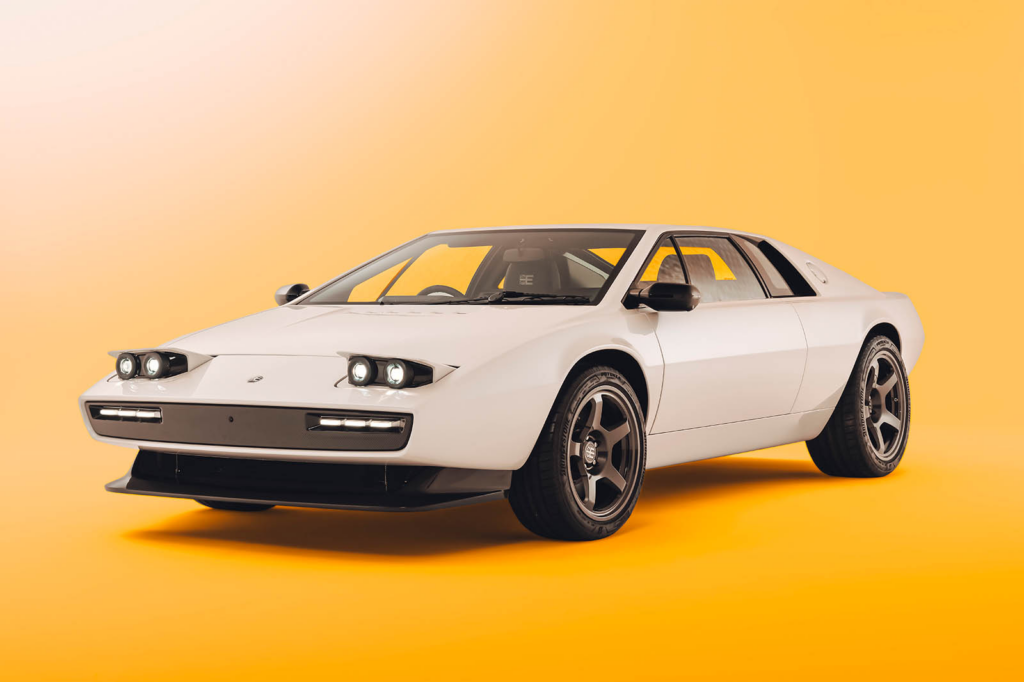
At its core, the Encor Series 1 masterfully blends the robust hardware of the post-1998 Lotus Esprit V8 with the timeless design language of the original four-cylinder, Giorgetto Giugiaro-penned 1976 model. The foundational genius of Colin Chapman’s original design principles – lightness, simplicity, and aerodynamic prowess – is not only honored but amplified. Encor achieves this remarkable synthesis by acquiring a donor Esprit V8, carefully liberating its glass-reinforced plastic body from the foundational steel backbone chassis. This chassis then undergoes a meticulous restoration and enhancement process, before being cloaked in a breathtakingly rendered, bespoke carbon-fiber body, a direct and eloquent tribute to Giugiaro’s inimitable styling.
The complexity of this undertaking extends far beyond a superficial aesthetic overlay. The original engine, suspension, and auxiliary systems are meticulously removed. The steel backbone chassis is stripped back to its bare metal, then subjected to a galvanization process, an unusual but critical step for an older British car, effectively eradicating any lingering concerns about rust. This robust foundation is then reassembled with a host of upgraded components. The suspension is painstakingly fine-tuned to mirror the specifications of the Sport 350 – the ultimate iteration of the Esprit V8 – and is then reassembled with entirely new bushings. While the majority of the components are genuine Lotus parts, including the responsive hydraulic power steering system, Encor has engineered stronger rear hub carriers. This crucial enhancement addresses a known and chronic vulnerability that has historically plagued the rear hubs of the Esprit V8, ensuring enhanced durability and peace of mind for the discerning owner.
Reimagined Powertrain: Forged Strength for Uncompromised Performance
The heart of the Encor Series 1 is the legendary 3.5-liter Lotus V-8 engine, internally designated the Type 918. This powerplant undergoes a comprehensive and exhaustive rebuild. Forged pistons are integrated to handle increased stress, while upgraded fuel injectors ensure optimal delivery. The turbochargers are completely re-engineered with new internals, a modern electronic throttle body is fitted, and the fuel and cooling systems are brought into the 21st century. A new, performance-oriented stainless-steel exhaust system is installed, promising a symphony of V8 acoustics. The five-speed transaxle, originally a Renault unit sourced by Lotus, has been collaborated on with the transmission specialists at Quaife. This partnership has resulted in significant enhancements, including a stronger input shaft – a critical upgrade that resolves a long-standing drivetrain weakness that compelled Lotus engineers to reduce the Type 918’s original 500 hp output to 350 hp upon the Esprit V8’s 1996 debut. The revised gear ratios and the inclusion of a helical limited-slip differential, coupled with a twin-plate clutch, not only improve drivability but also make the clutch action remarkably lighter and more manageable than the original. This meticulous attention to the drivetrain ensures that the Encor Series 1 is not only powerful but also reliable and a joy to operate.
A Stylistic Evolution: Honoring Giugiaro’s Vision with Modern Sensibility
While the Encor Series 1 proudly retains a strong visual echo of the original Giugiaro design, the evolution of the Esprit’s bodywork over its production life is acknowledged. Peter Stevens, whose illustrious career includes the iconic McLaren F1, and later Julian Thomson, who contributed to the Lotus Elise before his impactful tenure at Jaguar Land Rover working on vehicles like the first-generation Range Rover Evoque and the Jaguar F-Type, both left their indelible marks. The Encor Series 1’s bodywork, expertly sculpted by Encor’s Design Director, Dan Durrant, a former Lotus designer himself, represents a sophisticated distillation of Giugiaro’s razor-sharp, wedge-shaped concept first unveiled at the 1972 Turin Motor Show. Durrant articulates this philosophy with clarity: “We’re not handcuffed by the original,” he states, “but we’re completely inspired by it.”
The utilization of a one-piece carbon-fiber body has empowered Durrant to refine and simplify the car’s overall aesthetic, bringing it closer to the purity of Giugiaro’s 1972 vision in both form and detail. The characteristic black band encircling the original Esprit’s midsection, for instance, was a functional necessity to conceal the external flanges used to join the two-piece glass-reinforced plastic body. In contrast, the Encor’s seamless carbon-fiber construction allows for unblemished bodysides and a more elegant integration of the front and rear fascias.
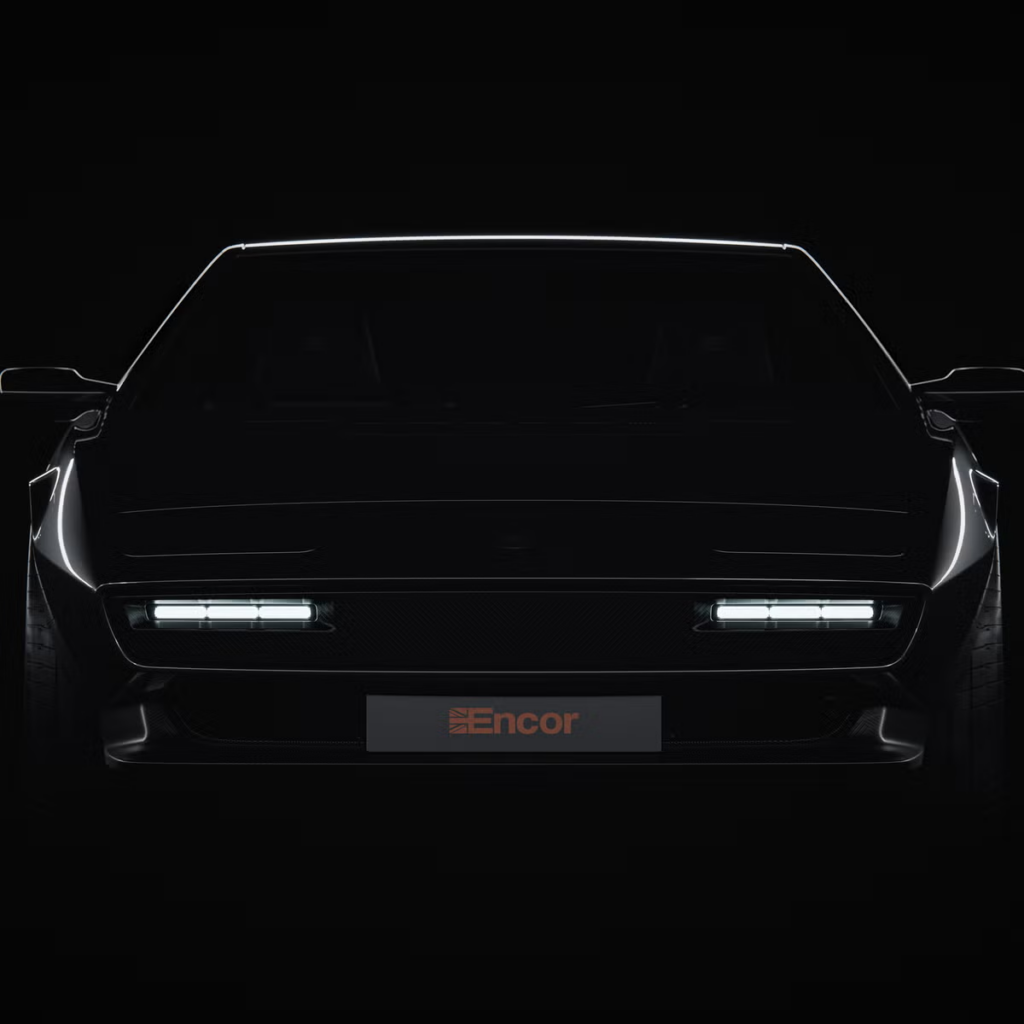
Durrant’s design thoughtfully preserves the flat roofline and the distinctive trapezoidal windshield of the original Esprit – a subtle nod to Giugiaro, as the Peter Stevens redesign had introduced a slight curvature to the roof. The subtle Kamm tail and the discreet front spoiler integrated beneath the tapered nose are also faithfully represented. The front and rear fascias are presented with a newfound simplicity and cleanliness compared to the production Esprit V8, featuring contemporary LED lighting at the front and elegantly designed LED taillights at the rear. Where the Esprit V8 concealed its engine beneath a utilitarian cover between buttressed C-pillars, the Encor Series 1 proudly showcases its V8 heart beneath a glass rear backlight, evoking the visual drama of the original four-cylinder model.
The wheels are a bespoke design: forged billet, five-spoke units, measuring 17 inches at the front and 18 inches at the rear, shod with generously profiled Bridgestone Potenza tires – a configuration reminiscent of the final Esprit V8 models. “Wheels were a real topic of discussion,” Durrant notes. “Inflate the wheel size too much, and you can completely unbalance the visuals of the car. It starts to look like a toy.” Behind these striking wheels, whose apertures are elegantly scaled-up versions of the original Esprit’s five-slot Wolfrace alloys, lie potent AP Racing brakes, ensuring formidable stopping power to match the car’s performance capabilities.
Two subtle yet instantly recognizable design cues that forge an immediate connection for Lotus aficionados are the six small vents positioned at the base of the windshield and the distinctive, inset fuel filler cap on the left C-pillar. “The silhouette and the key shapes on the car are very, very close to the Giugiaro original, but refined and honed in every way,” Durrant explains. “We’ve made just small adjustments here and there to add elements that wouldn’t have been possible when the car was originally produced. And because carbon fiber is such a robust and dimensionally accurate material, it means that we can do the things that customers want, like nice tight shut gaps and flush-mounted glass.”
Beyond its aesthetic refinement, the new carbon-fiber body bestows significant improvements in structural rigidity and occupant safety. Astonishingly, up until its discontinuation in 2004, the Esprit V8 utilized a plywood firewall between the engine bay and the cabin. The Encor body features a sophisticated double-layer carbon-fiber firewall that seamlessly integrates with the cant rails in the roof. These cant rails incorporate tubular carbon-fiber elements that extend down either side of the windshield to the structure supporting the dashboard and doors, and are also interconnected across the top of the windshield, effectively creating a formidable passenger safety cell. This commitment to safety is paramount in the design of the Encor Series 1.
A Symbiotic Interior: Nostalgia Meets High-Tech Sophistication
The interior of the Encor Series 1 masterfully echoes the spirit of the original Esprit, most notably in its iconic two-spoke steering wheel and the fundamental architecture of the center console. However, this classic foundation is elevated by the incorporation of premium materials and cutting-edge technology, imbuing it with a distinctly modern edge. The instrument panel serves as a prime example of this harmonious blend. The original Esprit’s free-standing, wraparound pod is reimagined as a sculpted light metal structure housing a state-of-the-art digital display at its core, flanked by smaller touchscreens artfully angled towards the driver. The central console further integrates a portrait-format touchscreen, providing intuitive access to vehicle functions and infotainment.
From the driver’s vantage point, the Encor Series 1 meticulously replicates the tactile experience of the original Esprit. The relationship between the steering wheel, shifter, and pedals remains unchanged, preserving the authentic driving engagement. While this fidelity to the original is a significant boon for enthusiasts, the inherent compactness of the Esprit’s cabin remains. Despite a wheelbase that is 6.6 inches longer than a contemporary Porsche 911, the original Esprit was notably lower, standing 8 inches shorter. Consequently, headroom can be a consideration for drivers exceeding six feet in height. Encor’s decision to retain the original Lotus seat frames for the Series 1 was driven not only by their inherent lightness but also by the fact that most modern seats are simply too tall to accommodate the limited vertical space.
Despite these physical constraints, Encor Managing Director William Ives assures that the Encor Series 1 is engineered for effortless daily usability. The inclusion of air conditioning is standard, alongside a comprehensive infotainment system. This advanced system, featuring high-end audio, has been meticulously designed and engineered by Ives’ primary enterprise, Skyships Automotive, a company renowned for supplying similar sophisticated equipment to exclusive, low-volume manufacturers such as Aston Martin, McLaren, and Pagani. Furthermore, any lingering specter of the infamous Lucas “Prince of Darkness” electrical issues associated with older British cars is definitively banished. The Encor Series 1’s entire electrical architecture, right down to the new electronic throttle body, has been conceived and executed by Skyships, representing the pinnacle of modern automotive electrical systems.
The vehicle presented is the inaugural prototype, poised to embark on rigorous testing to fine-tune the suspension dynamics. Given its anticipated lower weight compared to a production-spec Esprit V8, the spring and shock rates will undergo precise calibration, complemented by comprehensive final system checks and calibrations. For reference, the production Esprit V8 achieved 0-60 mph in a brisk 4.1 seconds and 0-100 mph in 10.2 seconds, completing the quarter-mile in 12.7 seconds at 112 mph. With an estimated 400-pound weight reduction over the production V8 and an increase of 50 horsepower, the Encor Series 1 is projected to eclipse these figures en route to its stated top speed of 175 mph.
Encor plans a limited production run of just 50 units over a two-year period, with manufacturing commencing in 2026. Importantly, the Encor Series 1 will be available in left-hand-drive configurations, catering to the significant U.S. market where nearly half of the approximately 1,400 Esprit V8s produced were originally exported, ensuring a healthy pool of donor vehicles for American enthusiasts. The base price is estimated at approximately $570,000 USD at current exchange rates, exclusive of shipping, taxes, and the cost of the donor Esprit V8. While undeniably a significant investment, it stands as a testament to the unparalleled level of engineering, craftsmanship, and exclusivity, positioning it as a compelling alternative to comparable 911 restomods boasting similar pedigree and meticulous attention to detail.
For those who yearn for an automotive experience that transcends the ordinary, the Encor Series 1 offers an unparalleled opportunity to own a piece of automotive history, meticulously reimagined for the modern era. Discover the ultimate expression of performance and design – explore the Encor Series 1 today and redefine your automotive journey.